Building Better Interprofessional Teams: How the ACU care model and SIBR Rounds Transform Teams and Collaboration

Building Better Interprofessional Teams: How the ACU care model and SIBR Rounds Transforms Interprofessional Collaboration
Communication failures remain one of healthcare's most persistent challenges. Research consistently shows that inadequate teamwork and fragmented communication contribute to high rates of medical errors and patient harm. In busy hospital environments, crucial conversations about patient care are often fragmented, missing input from key team members and all too frequently excluding the most important stakeholders: patients and their families.
But what if it didn’t have to be that way? What if there was a better way, a new normal?
Consider, if you will, the Accountable Care Unit (ACU care model) and its flagship process, Structured Interdisciplinary Bedside Rounds (SIBR). Together, these innovations offer a practical framework for building truly effective interprofessional teams and embedding interprofessional collaboration into daily clinical practice.
What Makes ACUs and SIBR Different?
The ACU model, developed at Emory University Hospital in 2010, aims to transform inpatient units into highly functional clinical microsystems. It comprises four interconnected elements: geographic localisation of providers, unit-based quality metrics, nurse-physician leadership partnerships, and SIBR (Stein et al., 2015, Schwartz et al., 2021).
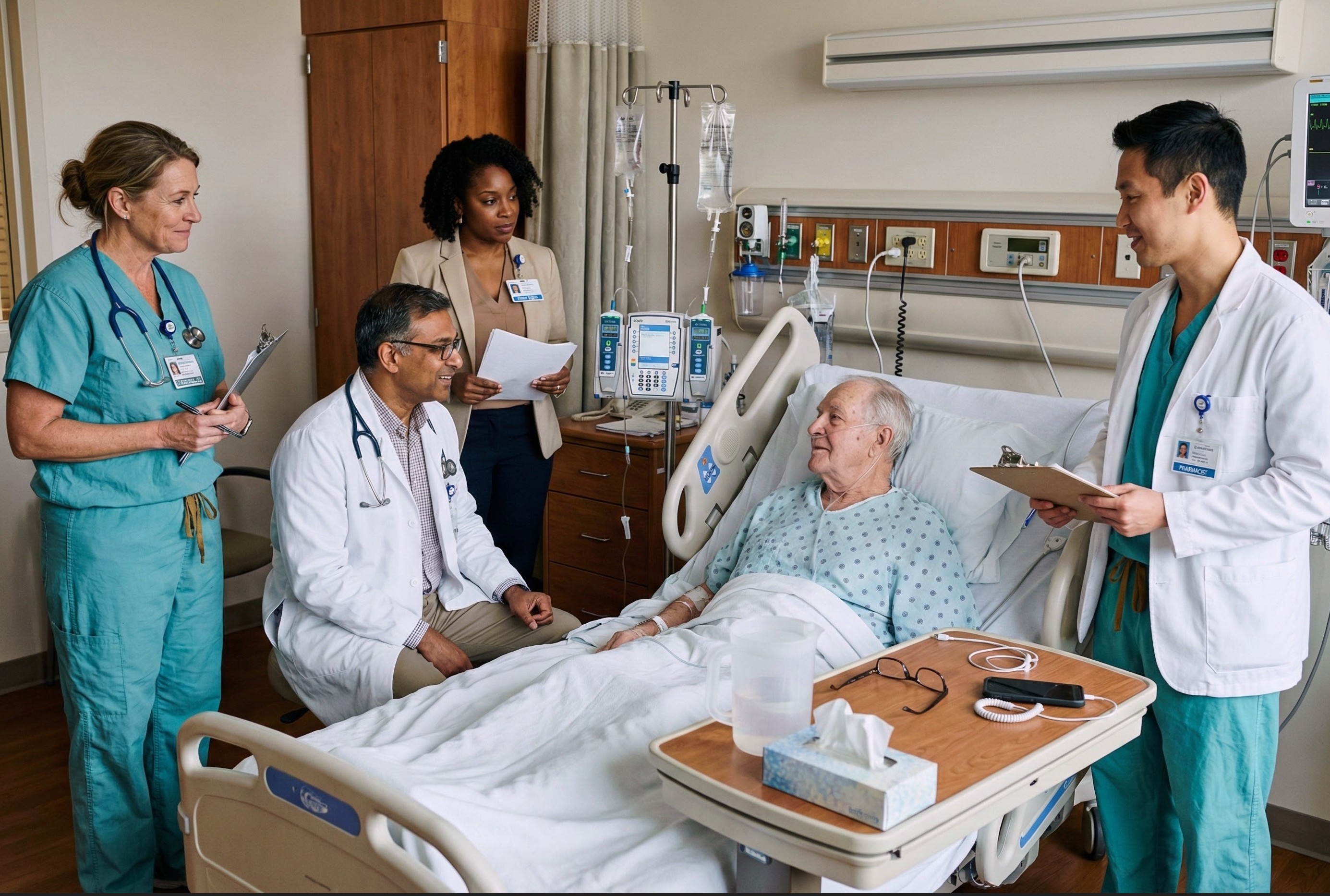
SIBR itself is a brief, highly-efficient standardised team-based intervention lasting three to four minutes per patient. It brings together nurses, physicians, pharmacists, care managers, and allied health professionals at the patient's bedside to discuss care plans, discharge goals, and safety concerns and all with the patient and family as active participants (Stein et al., 2015).
Evidence of Improved Interprofessional Collaboration
Research demonstrates that SIBR significantly enhances how interprofessional teams communicate and work together. A quasi-experimental study at Yale found that both residents and nurses reported significantly improved quality of interprofessional communication following SIBR implementation. Notably, 93% of residents rated communication as good or excellent during SIBR, compared with 68% beforehand (Schwartz et al., 2021).
The benefits extend across professional boundaries. A comparative study on an Acute Care for the Elderly (ACE) unit found that staff participating in SIBR rated teamwork, communication, and understanding of the care plan significantly higher than colleagues on units using traditional physician-centric rounds. Staff also felt better equipped to address patient fears and worries, and reported improved communication with families (Gausvik et al., 2015).
Qualitative research reveals that SIBR creates a more level playing field between professions. An Australian multi-method evaluation found that the structured rounds disrupted traditional hierarchical communication patterns, with non-medical professionals feeling more empowered to voice their perspectives both during and outside rounds (Clay-Williams et al., 2018). As observed, SIBR rounds provided much greater visibility of the "big picture" and each profession's role within it, allowing clinicians to adjust their work to account for others.
The Power of Structured Interdependence
What distinguishes effective interprofessional collaboration in the ACU model is intentional interdependence. Rather than parallel working, where each profession operates independently, SIBR creates structured moments where team members actively share and integrate their knowledge.
Research exploring resident physician teamwork behaviours found that educational approaches combining interdependent interprofessional work with explicit teaching significantly improved collaborative practice. Residents demonstrated improvements in specific behaviours such as inviting patient and family contributions, avoiding medical jargon, and proposing plans for the day. These findings suggest that clinical environments with intentional interdependent structures can help bridge the gap between interprofessional education and true interprofessional practice (Mastalerz et al., 2021).
The ACU's physician-nurse leadership dyad further reinforces this collaborative culture. One observational study found that authentic unit ownership and collaborative leadership contributed to meaningful clinical improvements, including reduction in unexpected deaths to zero in the third year of implementation (Loertscher et al., 2021).
Patient Safety and Beyond
Strong interprofessional teams are not merely a nice-to-have: they are fundamental to patient safety. Research consistently links inadequate communication to adverse events, with several analyses identifying communication as a contributing factor in over 50% of reported incidents.
SIBR addresses this by incorporating structured safety checklists and ensuring all team members share a common understanding of the care plan. Physician perspectives captured through qualitative interviews emphasised that bedside rounds increase collaboration and trust among team members, enhance safety and efficiency, and contribute to a stronger teamwork culture (Mastalerz, Jordan & Townsley, 2024).
Practical Implications for Healthcare Leaders
For hospital leaders and quality improvement teams considering ACU implementation, the evidence offers several insights. First, interprofessional collaboration improves when it is operationalised through structured processes rather than left to chance. Second, successful implementation requires engagement across all professional groups, with iterative refinement based on staff feedback. Third, culture change takes time, with some research indicating that the full benefits may only emerge months after structural changes are in place.
Perhaps most importantly, the ACU model demonstrates that transforming interprofessional teams does not require additional staffing or resources. The Yale study, for instance, achieved over 95% participation from core team members using existing personnel (Schwartz et al., 2021).
Conclusion
In an era of increasing healthcare complexity, effective interprofessional collaboration is essential. The ACU and SIBR model offers a practical, evidence-based approach to building interprofessional teams that communicate better, work together more effectively, and ultimately deliver safer, more patient-centred care. For hospitals seeking to strengthen their collaborative culture, the message is clear: structure matters, and the bedside is the right place to start.
References
Mastalerz KA, Jordan SR, Foley D, et al. (2021). Improving Resident Physician Interprofessional Collaborative Practice during Bedside Interdisciplinary Rounds. Journal of Interprofessional Education and Practice, 25, 100473.


