What is SIBR? And how can it help with hospital capacity problems?

What is SIBR? Unlocking Hospital Capacity Through Better Communication
Every hospital leader knows the frustration: beds occupied by patients who could have been discharged yesterday, if only someone had noticed the missing medication, the pending social work referral, or the family's unanswered questions. These are not clinical problems, they are communication problems. And they are readily solvable.
The Joint Commission has identified communication failure as a root cause in over 60% of reported sentinel events. But beyond patient safety, poor communication creates a hidden tax on hospital capacity. When care teams work in silos, discharge barriers go unnoticed until they become discharge delays. Patients stay longer than necessary, beds remain occupied, and emergency departments back up, all while staff work harder, not smarter.
What is SIBR?
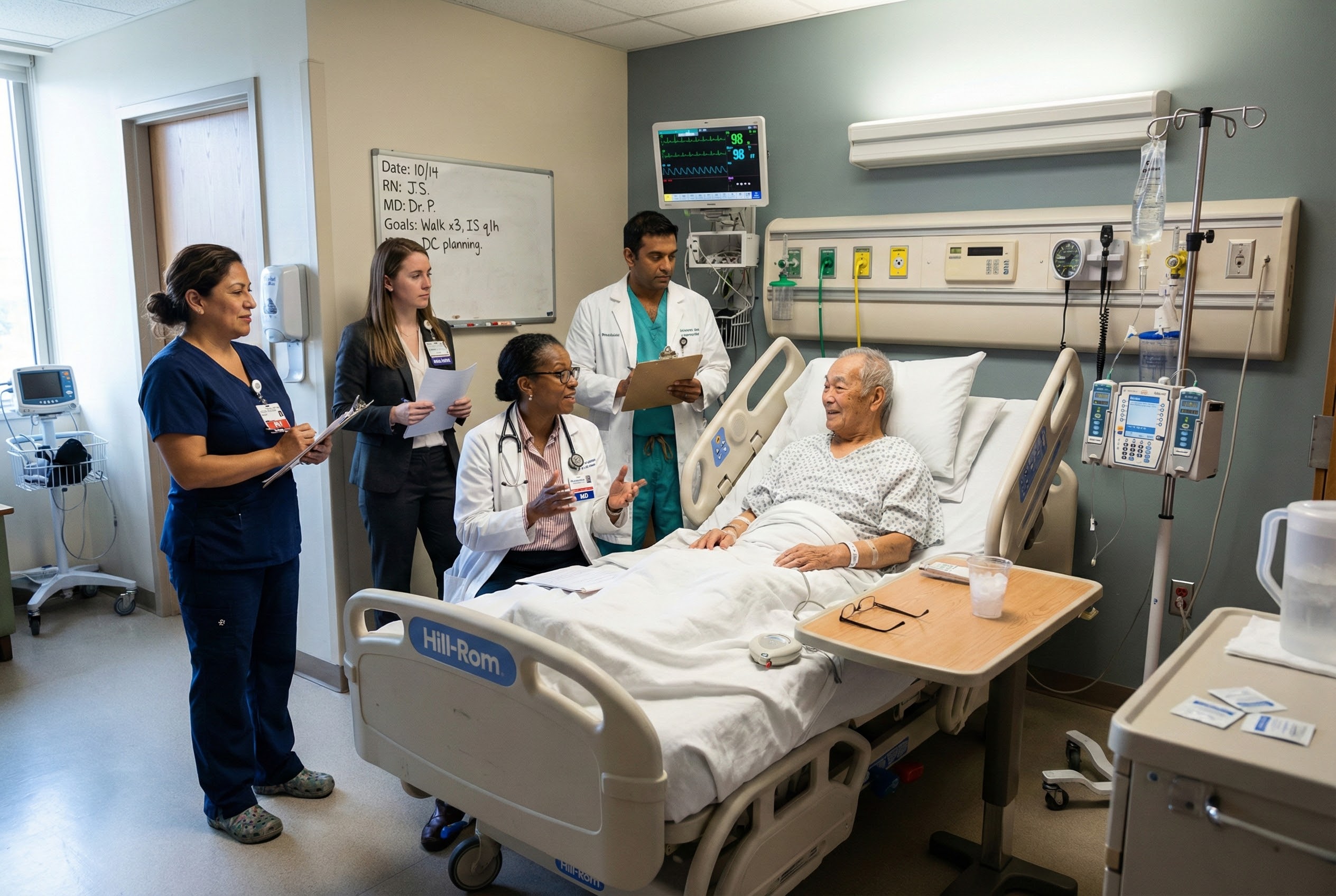
Structured Interdisciplinary Bedside Rounds (SIBR, pronounced "cyber") is an evidence-based approach that fundamentally reimagines how hospital teams communicate. First developed at Emory University Hospital in 2010, SIBR brings together the entire care team (physicians, nurses, pharmacists, social workers, and the patient and their family) at the bedside to discuss treatment plans, anticipated discharge dates, and barriers to going home.
The key innovation is not simply meeting at the bedside, but the structured conversation that takes place there. Each SIBR encounter follows a standardized format: the physician provides a brief clinical synopsis, the nurse reports on safety concerns, the pharmacist addresses medication issues, the social worker or care manager reviews discharge planning, and the patient is invited to cross-check everything. Critically, each discussion explicitly addresses anticipated discharge timing and any barriers that might delay it.
Identifying Barriers Before They Become Delays
In traditional care models, discharge planning often happens in fragments. The physician may be ready to send a patient home, only to discover that the social worker hasn't been informed, the family hasn't been taught how to manage medications, or there's a financial barrier to obtaining prescriptions or placement. These discoveries typically happen late in the day, or worse, the morning of discharge adding unnecessary bed days.
SIBR changes this dynamic by ensuring that every member of the care team discusses their perspective on discharge readiness simultaneously. During SIBR, each team member explicitly discusses the anticipated discharge date and any barriers, with patients given the opportunity to ask questions about their care plan (Sunkara et al., 2020). This proactive identification means problems are solved in real time rather than discovered after the fact.
The interdisciplinary nature of SIBR proves particularly valuable for addressing complex barriers. Having a pharmacist present at rounds enhanced awareness of financial barriers that might limit patients' ability to obtain discharge medications, enabling the team to identify less costly alternatives before discharge rather than after a failed medication collection (Sunkara et al., 2020).
The Evidence: Fewer Returns, Better Flow
The capacity benefits of improved communication are measurable. A study comparing SIBR to standard care found that patients on SIBR units had 30% lower odds of being readmitted within seven days of discharge. While 30-day readmission rates showed improvement (16.6% versus 20.3%), it was the reduction in early readmissions that proved most striking, suggesting that better discharge preparation translates directly into more sustainable transitions home (Sunkara et al., 2020).
From an operational perspective, research from Australia demonstrated a statistically significant reduction in the cost of care delivery on SIBR wards compared to control units. Qualitative findings revealed that staff perceived work processes to be more efficient, particularly through elimination of time spent "chasing" other professionals who were now predictably available during rounds. More timely decision-making resulted from this predicted availability and associated improvements in communication (Clay-Williams et al., 2018, Journal of Hospital Medicine).
Staff also reported that better-informed patients required less ongoing attention. As one nurse explained, patients who understood their care plan used the call bell less frequently throughout the day: a small efficiency gain that compounds across an entire ward.
Doing More With What You Have
For hospital leaders facing persistent bed pressures, SIBR offers something increasingly rare: a way to improve capacity without additional resources. The intervention requires no new staff, no capital investment, and little technology beyond what hospitals already use. What it requires is commitment to structured communication and the discipline to bring the right people together at the right time.
Research consistently shows that SIBR improves interprofessional communication significantly, from 67.9% to 93.3% among residents, and from 36.0% to 73.7% among nurses. Residents reported receiving fewer interrupting pages, suggesting that questions were resolved during rounds rather than fragmenting the workday (Schwartz et al., 2021).
The logic is straightforward: when teams communicate better, they identify and solve problems faster. When barriers to discharge are addressed proactively, patients go home when they're ready and not just when someone finally notices they've been waiting. When patients understand their care plan before leaving, they're less likely to return within days because something went wrong.
A Practical Path Forward
SIBR is not a panacea, and implementation requires attention to workflow and leadership commitment. Research highlights that sustainability demands ongoing focus, and benefits may diminish without maintained enthusiasm. But the fundamental insight remains powerful: structured communication at the bedside addresses root causes of inefficiency that no amount of bed management software can solve.
In an era of constrained resources and growing demand, the question for hospital leaders is not whether they can afford to implement SIBR, but whether they can afford not to.
References


